> For the complete documentation index, see [llms.txt](https://docs.aozo.io/llms.txt). Markdown versions of documentation pages are available by appending `.md` to page URLs; this page is available as [Markdown](https://docs.aozo.io/stake/protocol-and-security/cross-chain-architecture.md).
# Cross-chain architecture
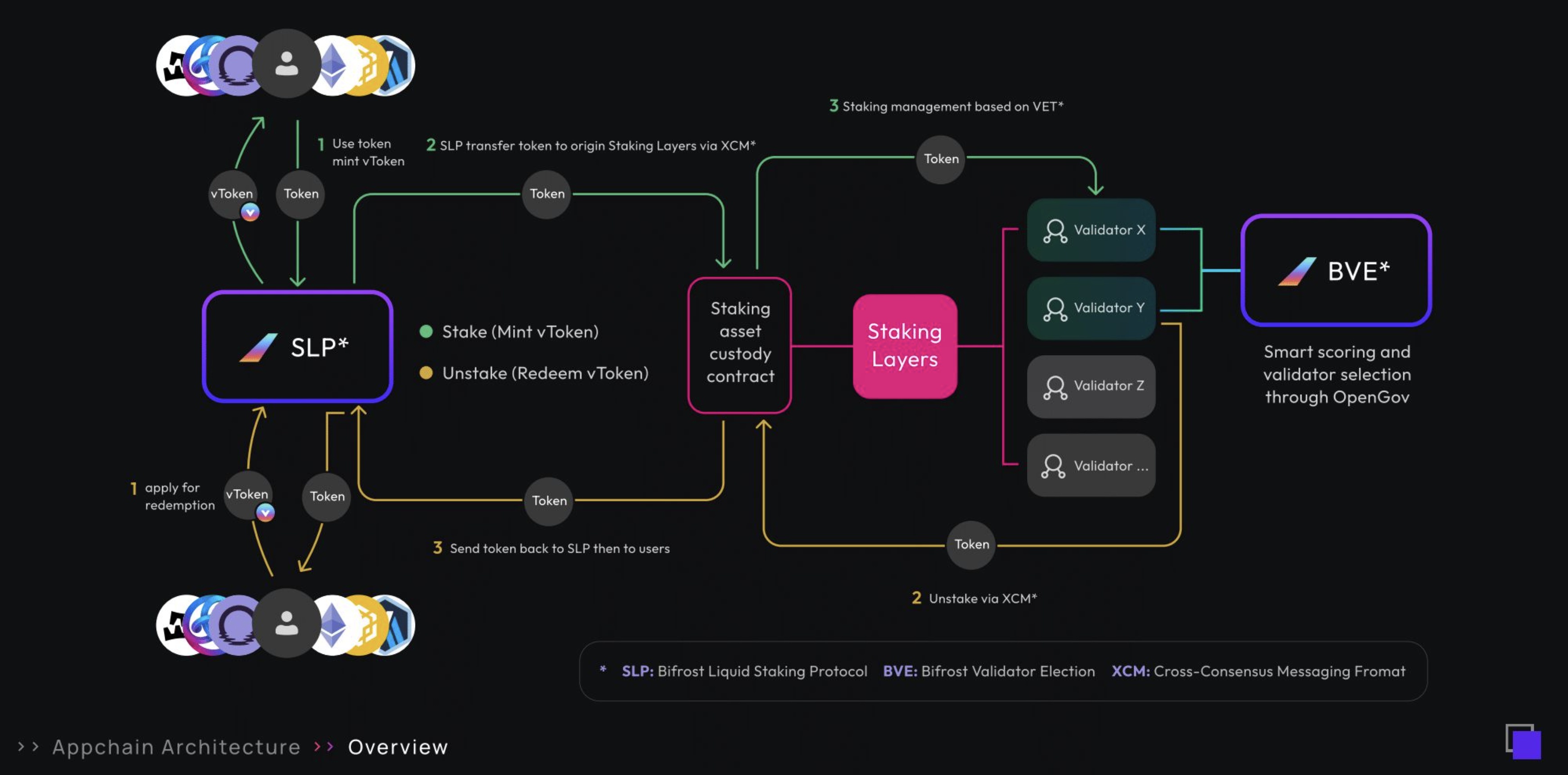
SLPx lets users mint and use vTokens from supported chains through cross-chain remote calls.
### Bifrost's approach
Unlike Ethereum liquid-staking protocols, Bifrost has supported Polkadot's omni-chain ecosystem from inception. This approach addresses cross-chain friction when minting and using vTokens.
### Why use a cross-chain architecture?
To understand the need for cross-chain architecture, consider a user who intends to mint vGLMR. They must first transfer GLMR from Moonbeam to the Bifrost-Polkadot chain. After minting, if the user wishes to use it on Moonbeam, they must transfer the vGLMR back to Moonbeam. This complex process requires multiple transactions, making it cumbersome for the user.
However, Bifrost's cross-chain architecture and SLPx module simplify these complexities. They offer users a seamless experience by combining all vToken minting processes into one transaction on a single chain.
### How SLPx mints vGLMR
Instead of deploying SLP modules on multiple chains, Bifrost allows other chains to use existing SLP modules on Bifrost-Polkadot, Bifrost-Kusama, and Ethereum through cross-chain remote calls.
1. A user submits a vGLMR mint request on Moonbeam.
2. Moonbeam transfers GLMR to Bifrost-Polkadot through a remote call.
3. Bifrost-Polkadot mints vGLMR and returns it to Moonbeam.
Users experience the mint from Moonbeam. The underlying cross-chain operations remain abstracted.

The redemption of vGLMR to GLMR and swaps follows a similar mechanism.
{% hint style="info" %}
Users interact with the chain they are on. Remote calls coordinate the required operations across chains.
{% endhint %}

### Advantages
#### Unified liquidity
Bifrost eliminates the need to bootstrap the liquidity of vTokens on multiple chains by consolidating liquidity onto a single chain. This optimization reduces user transaction fees and improves overall efficiency.
For example, when users want to swap vGLMR to GLMR, they can utilize the unified liquidity pool on the Bifrost-Polkadot chain via remote calls. This approach ensures better transaction prices and execution, avoiding the additional costs associated with bootstrapping liquidity on other chains like Moonbeam.
#### Cross-chain composability
{% hint style="info" %}
Have a look to the blog article: [Bifrost Tokenomics and vTokens Application Scenarios](https://bifrost.io/blog/bifrost-tokenomics-and-vtokens-application-scenarios)
{% endhint %}
Furthermore, when a DeFi project seeks to integrate vTokens, it no longer needs to integrate SLP modules from different chains separately. Instead, the project only needs to communicate with the primary SLP protocol on a single chain (or a few selected chains).
The SLP modules on Bifrost-Polkadot, Bifrost-Kusama, and Ethereum maintain the global and comprehensive status of vTokens. Ideally, in a fully interoperable blockchain ecosystem, the SLP module on Bifrost-Polkadot will hold the global and comprehensive status of vTokens, streamlining the integration process for various DeFi projects.
---
# Agent Instructions
This documentation is published with GitBook. GitBook is the documentation platform designed so that both humans and AI agents can read, navigate, and reason over technical content effectively. Learn more at gitbook.com.
## Querying This Documentation
If you need additional information that is not directly available in this page, you can query the documentation by asking a question.
Perform an HTTP GET request on the following URL with the `ask` and `goal` query parameters:
```
GET https://docs.aozo.io/stake/protocol-and-security/cross-chain-architecture.md?ask=&goal=
```
`ask` is the immediate question: it should be specific, self-contained, and written in natural language.
`goal` is what the user is ultimately trying to achieve, the reason they need the answer. Sharing it helps GitBook give you a better, more relevant answer. A goal is most helpful when it describes the outcome the user wants rather than restating the question. For example, with `ask=how do I create an API token`, a goal like `automate deployments from our CI pipeline` lets GitBook tailor the answer to that use case.
The response will contain a direct answer to the question and relevant excerpts and sources from the documentation.
Use this mechanism when the answer is not explicitly present in the current page, you need clarification or additional context, or you want to retrieve related documentation sections.